Pitfall #1: A napkin is not a spec
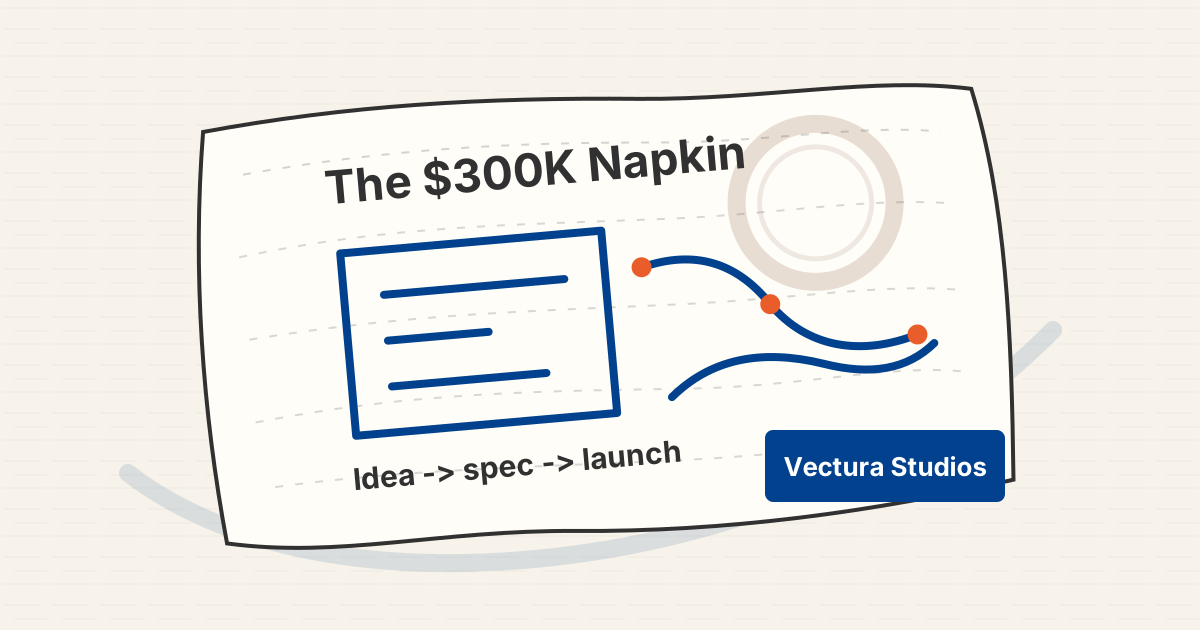
A client hired us to run their CRM program, execute their marketing plan, and manage their martech stack. During discovery, they mentioned something else: a digital app that had been "in development" for a year, with about $15,000 spent and nothing to show for it. We took that project on too.
The $15,000 had gone to a talented developer working from notes scribbled on the back of a napkin. The company was onto something real: a tech tool meant to supplement their consulting work and increase retention and stickiness with their existing clients. The execution was the problem.
The stack the developer had already committed to was monolithic, built for multi-billion-dollar companies, and designed to behave like a large consumer platform instead of a custom application for a small business. It was inflexible, rigid, and expensive to customize around the client's actual workflow. None of that showed up in the napkin notes, because napkin notes cannot show requirements, integrations, or the actual shape of a client's delivery model. They can only show intent.
We pivoted the technical approach to something more appropriately scoped for the business it needed to serve. Then the developer stepped away to focus on a different client, one who had just put $3 million behind a product he'd built for them. That is a reasonable business decision for a developer to make. It is also exactly the kind of dependency a small consultancy cannot afford to build its entire digital future on.
Pitfall #2: Losing the driver loses the vision
We architected the requirements from scratch, built a working prototype, and got it to market before our engagement with the client ended. In a lot of case studies, that is where the story ends well. It did not end there this time.
The next person to pick up the product on the client side brought in a new developer and started over, again, instead of building on the working prototype and the requirements already in place. Meanwhile, a different person inside the same company was quietly building a competing app for the same purpose. Neither side seems to have known, at first, that the other was spending real budget on the same problem.
Money kept flowing into both efforts. In total, over $300,000 was invested across the two parallel, uncoordinated builds. The result: two products that do not talk to each other, launched into the same market, neither one at breakeven.
This is the part of the story that has nothing to do with code. A monolithic stack is a technical mistake and it is recoverable. A rotating cast of owners with no shared, disciplined definition of the product is a structural mistake, and it compounds every time ownership changes hands.
The lesson
The digital future gets messy fast when nobody owns a consistent vision of what "done" looks like. Three development houses, no continuity of vision, and a product that drifted from its original purpose, a turnkey way to deliver the consultancy's own service through digital channels, into something nobody had actually asked for.
Building an MVP and getting it to market with paying users is cheaper today than it has been in a very long time. The hard part was never the cost of development. It is holding a single, consistent definition of minimum: not the product you imagine ten years from now, the one you can test, get feedback on, and iterate on now, with the same person accountable for it from the first sketch through launch.
What the market actually looked like
The platform was meant to serve two very different buyers:
- Enterprise buyers — using part of the suite in a multi-tenant, multi-SBU environment, affordable enough to be sticky, priced to build recurring profit.
- Small businesses — using the full suite in a self-service, multi-tenant environment, delivering the full experience at a price point that scaled.
In this client's vertical, there were roughly 3,500 companies in the enterprise class and 85,000 small businesses. The enterprise solution promised stickiness, continuity, and retention. The small business solution promised something bigger: significant recurring revenue across a much larger audience, at an acquisition cost roughly a tenth of the enterprise cost. On paper, the small business tier was always going to dwarf the enterprise one in planned revenue. That is the kind of insight a committed, single-owner product vision tends to surface early, while there is still time to act on it. A napkin, three developers, and a year of drift buried it instead.
Why this keeps happening
None of this failed because the underlying idea was bad. It failed because of focus, infighting, and scope creep, the same three things that quietly kill most internal digital builds at consultancies. Nobody involved was wrong about the size of the opportunity. Nobody stayed in the room long enough, with enough authority, to ship one version of it and let the market react before changing course again.
It is a pattern worth watching for on your own team:
- A build that has changed hands more than once, with each new owner restarting instead of extending.
- Two people, or two departments, quietly working the same problem without a shared spec.
- A stack chosen for a company ten times your size, because it looked more "serious," not because it fit.
- A definition of "done" that keeps growing every time someone new joins the conversation.
Any one of these is a warning sign. All four together is close to a guarantee that the budget outruns the product.
What we would have done differently, start to finish
If we had owned this project end to end instead of joining mid-flight, the sequence looks nothing like what actually happened. The napkin notes still start it, because that is genuinely how most good ideas begin. But the next step is a short, structured discovery: who are the two or three real buyers, what does each of them actually need on day one, and what is the smallest version of the product that proves the model works with real money changing hands. That discovery takes days, not months, and it produces a spec a developer can actually build against instead of a set of notes a developer has to guess at.
From there, one team stays accountable through the build, the launch, and the first round of user feedback. Ownership does not change hands mid-project because a developer's other client scaled up, and it does not fork into two competing efforts because two people inside the same company both had a reasonable idea about how to solve the same problem. A single owner also means the enterprise-versus-small-business question gets answered with real numbers early, instead of getting buried under a year of rebuilding. In this client's case, that number was stark: a tenth of the acquisition cost, against a market more than twenty times larger. That is not a detail to discover after $300,000 is already spent. It is the first thing a disciplined MVP process should surface.
How Vectura Studios is built differently
There are great ideas on napkins all over the world. Vectura Studios exists to take yours from napkin to market in under 30 days, and from MVP to core implementation in under 90. We hold the vision, the scope, and the delivery under one roof, with one team accountable from the first sketch through launch, so you do not end up with three developers, two competing internal projects, and a $300,000 lesson in what "minimum viable" was supposed to mean.
Maybe don't put a glass of water on that napkin. It's time to build a pillar to your business. What's holding you back?